Wedding's Zero-Waste Center Promises Cleaner Streets—And A Private CRM Owns Your Sorting Habits
Officials tout circular economy cred; the nearly invisible consent slip tucked in your reusable bag reveals the real beneficiary: a data broker hungry for your habits.
By Jax Delayski
Transit Meltdown & After-Hours Logistics Reporter
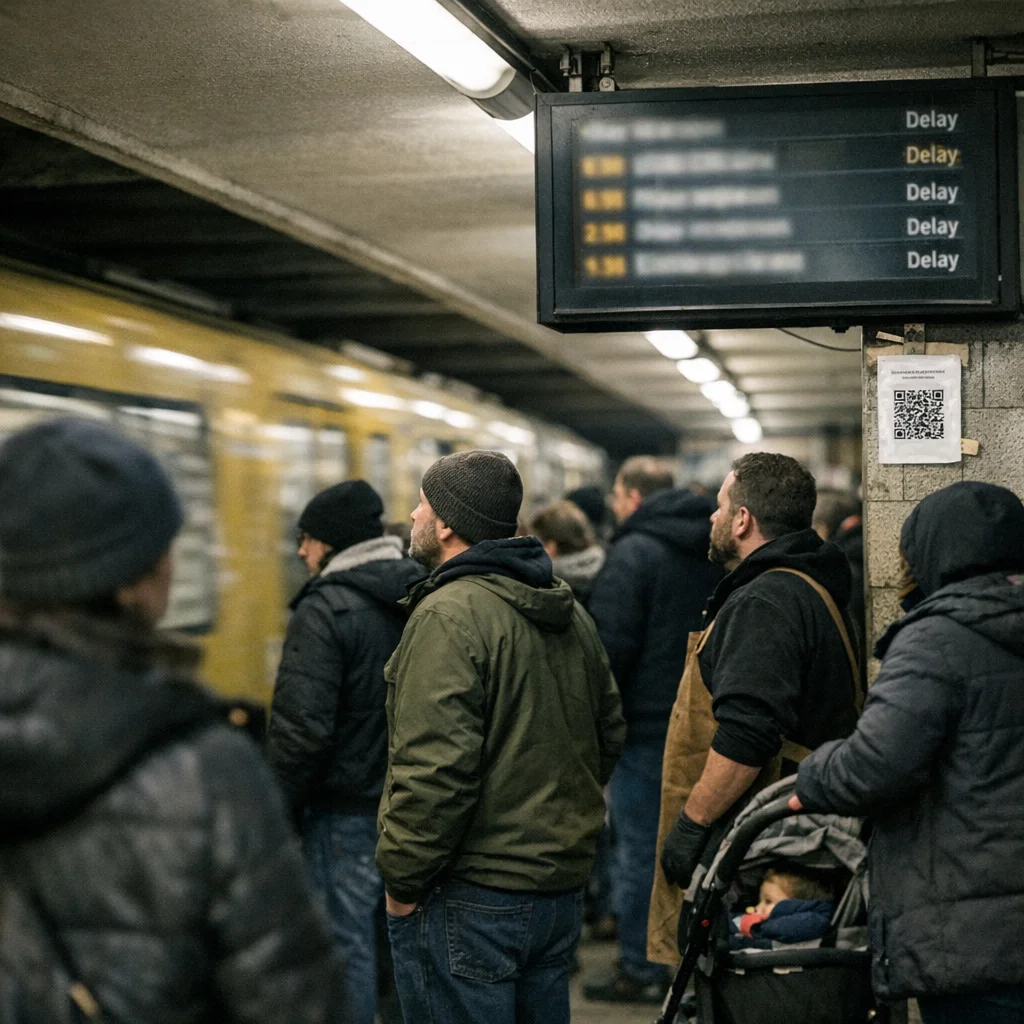
Around 9:40 am, commuters in Wedding discovered the newest BVG service concept: the U-Bahn arrives whenever it feels emotionally safe, and you’re expected to clap for its boundaries.
The trouble started when multiple trains on the northbound line were delayed “due to an operational disruption,” a phrase so empty it could rent a studio. Platforms filled with the usual cross-section of the neighborhood: Turkish shop workers trying to open on time, parents doing the one-handed stroller waltz, and newcomers practicing mindfulness while aggressively occupying three square meters.
BVG’s official narrative—posted on screens and repeated by the station voice that sounds like it hasn’t slept since reunification—was simple: technical issue, please be patient. The detail that punctured it was smaller, printed where nobody reads: the disruption notice included a QR-linked “feedback” form that asked riders to select their reason for travel from a menu that went far beyond “work” and “school.” Options reportedly included “medical appointment,” “childcare,” and “job interview,” the sort of intimate taxonomy you usually share after a third date or a court order.
“It’s not just a delay anymore,” said Aylin Demir, a bakery employee who watched two packed trains slide past without stopping. “It’s a questionnaire. I didn’t even get a seat before they asked where I was going and why. At least buy me a coffee first.”
By late morning, riders began comparing notes: those who completed the form received a cheerful auto-reply suggesting “alternative routes,” along with coupon-style nudges for nearby businesses. Nothing says public transport like a firm grip on your commuting patterns and a gentle push toward artisanal lentils.
A BVG spokesperson, Ronny Kessler, defended the form as “voluntary service optimization.” He insisted the categories help “understand mobility needs” and denied it was a commercial operation. “We’re not interested in private lives,” Kessler said, before adding that the tool helps “target information more precisely,” which is a romantic way to describe sliding into your inbox.
Transit advocates weren’t convinced. “This is Michel Foucault with a ticket validator,” said local mobility organizer Nadine Schulz. “Discipline and punish, but make it a commute.”
By early evening, BVG screens still flashed delays, and the QR form remained in place—now with a longer list of reasons, because bureaucracy, like desire, never stops expanding once you let it in.
District officials said they would “review” the feedback process. In Wedding, that usually means the trains will be fixed shortly after everyone has moved away—or learned to enjoy waiting as a lifestyle.