Who needs solvency when you’ve got a subsidy? Wedding’s residents test-drive the new E-car delusion
As Berlin debates fresh EV cash while the national balance sheet sweats through its shirt, Wedding responds with the only credible plan: buy virtue on credit and park it on the sidewalk anyway.
Späti Macroeconomics & Local Delusion Reporter
Berlin’s political class is flirting—again—with the idea of a shiny new E-car premium while the country is already wearing a few billion euros of debt like an ill-fitting designer jacket. Experts, allegedly sober, are warning Friedrich Merz that this is “missing the point.”
In Wedding, missing the point is our municipal religion.
A premium for the vibes, not the math
The pitch is simple: give people money to buy electric cars, and everyone becomes cleaner, quieter, and more ethically aroused by their own steering wheels. The debt? Details. Germany is basically trying to do Brechtian theater with the federal budget: the numbers are props, the message is “feel something.”
Meanwhile in Wedding, the neighborhood economy has already perfected this model.
Residents here don’t ask, “Can we afford it?” They ask, “Can we justify it?” Which is the same question, only with better branding and a tote bag.
Wedding’s new status symbol: the financed conscience
On paper, an EV premium is meant to accelerate decarbonization. On the street, it accelerates something else: a fresh wave of people buying a car they don’t need in a district where they don’t have a place to put it.
Local sightings already include:
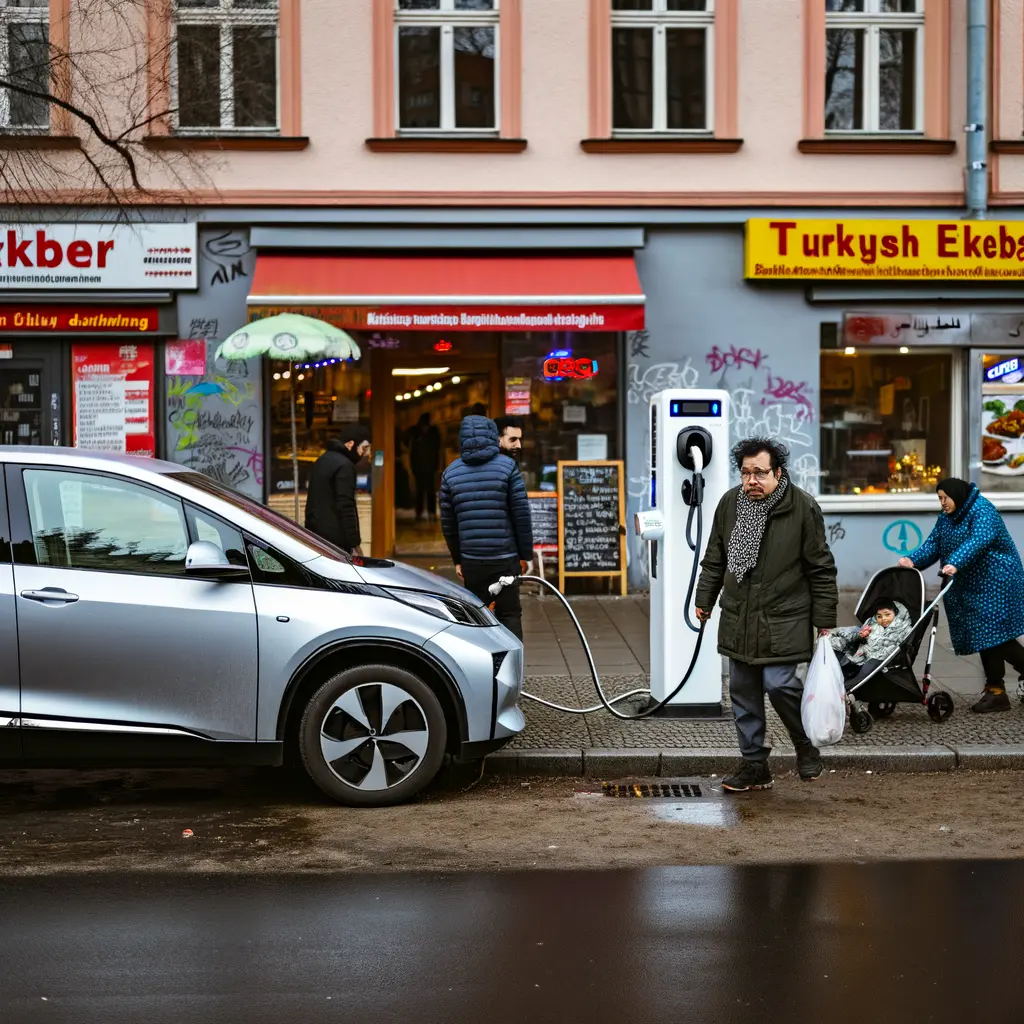
- A brand-new electric SUV parked half on the sidewalk, half in denial—its charger cable dangling like a self-congratulatory metaphor.
- A startup product manager from Mitte explaining to a Turkish barber on Müllerstraße that the battery “pays for itself,” a sentence as hard to swallow as the last bite of a dry simit.
- A person who claims they are “car-free,” except for the car they own “for emergencies,” where “emergency” means IKEA and feelings.
This is Walter Benjamin’s aura, but with torque.
The Merz problem: it’s not the car, it’s the cosplay
Experts warning Merz are basically saying: the problem isn’t only technology, it’s infrastructure, incentives, energy prices, and—minor detail—having money. A premium without a plan is like handing out condoms at a monastery: you’ll still meet stiff resistance, but now everyone’s debating symbolism.
In Wedding, symbolism wins every time.
Here, the EV is less transportation and more performance art—Marina Abramović if she owned a wallbox and silently judged you for taking the bus.
You can watch the spectacle unfold outside Leopoldplatz: drivers hunting for a charger like they’re characters in Tarkovsky’s Stalker, wandering a bleak zone where hope exists only in faint blue LEDs.
A neighborhood committee attempts to penetrate reality
At a recent informal gathering (a/k/a “five people arguing near a kiosk”), locals proposed practical uses for the premium that would better suit Wedding’s ecology:
- A subsidized extension cord long enough to reach from the fourth floor Altbau window to the curb. It’s community energy, with a fire risk you can really feel.
- A government-funded apology to every cyclist nearly flattened by someone “just looking for a charging spot.”
- Battery-powered morality meters that automatically post your sanctimony level to your group chat whenever you say, “Actually, it’s about sustainability.”
The meeting ended, as all Berlin civic life must, with nobody doing anything and one person recommending a podcast.
Debord’s spectacle, now available with heated seats
Let’s be honest: the EV premium debate is Germany trying to buy its way out of a systems problem. It’s “solutionism,” but with nicer interior lighting.
And Wedding will embrace it, because we love two things:
1) pretending individual purchases fix structural failures, and 2) driving around the block for 20 minutes to find parking while explaining to ourselves we’re saving the planet.
It’s late-capitalist mysticism: a deep dive into conscience, funded by a state that can’t quite remember where it left its calculator.
The only sustainable thing in Wedding? The delusion
If Merz wants to know what “missing the point” looks like, he can come to Wedding and stand quietly next to a brand-new EV occupying a stroller ramp.
He’ll hear the gentle hum of progress, smell the ghost of kebab smoke from the corner, and witness the real Berlin innovation cycle:
A crisis becomes a policy. A policy becomes a premium. A premium becomes a lease. A lease becomes a personality.
And the debt, like a forgotten Döner wrapper, drifts down the street until someone else picks it up. Probably never.