‘Write him cheap’: MDR’s dead now do copywork
A new AI voice package promises to revive old television voices for a modern audience, but the real labor is making the deceased sound even more like a budget moderator from a compliance webinar.
Administrative Grief Correspondent
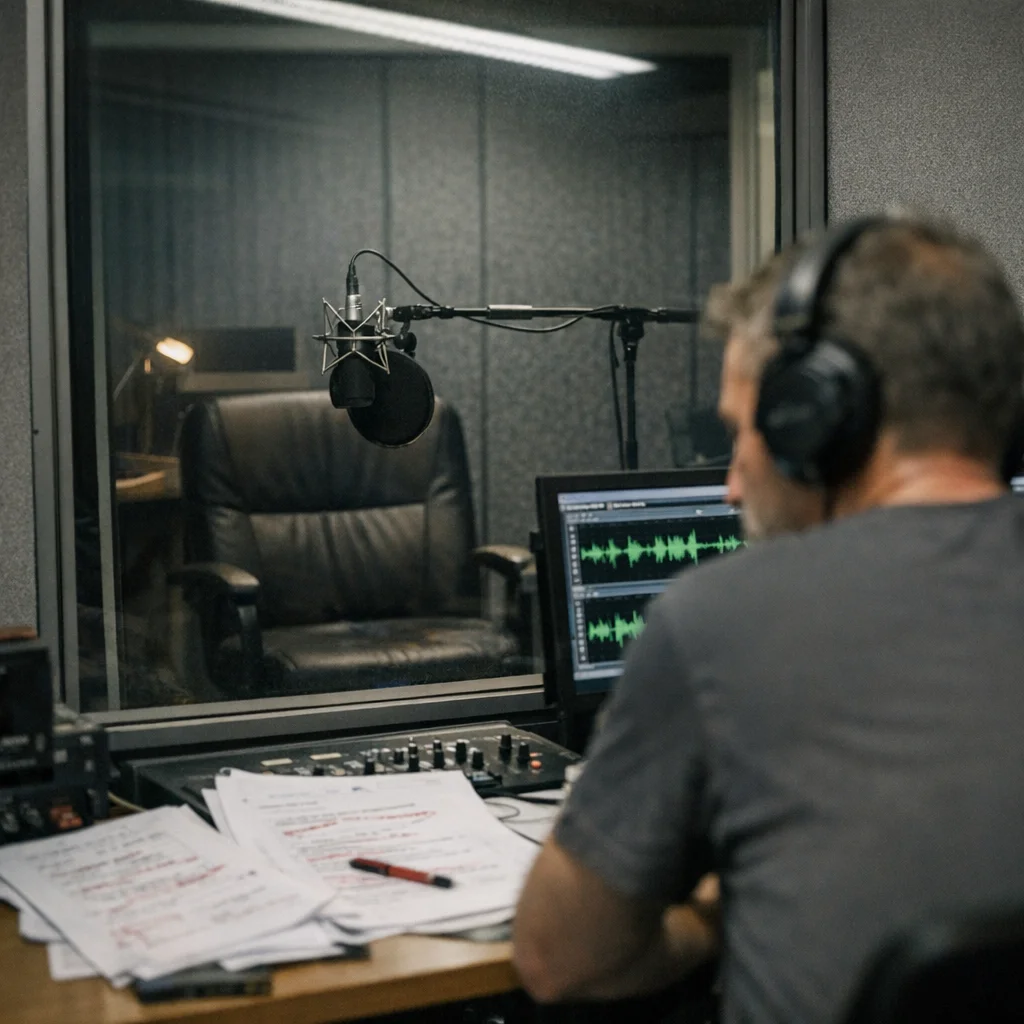
At MDR’s dubbing studio in Leipzig, the dead are being made to sound cheaper, nicer, and only marginally less dead than the living. The broadcaster’s new AI voice package arrives dressed as preservation, but the room smells like procurement, damp carpet, and moral cowardice in a pressed shirt. The promise is that old presenters can return to the microphone. The actual product is a synthetic briskness that sounds like it has been coached by a man in middle management who apologizes before he lies.
The official line is museum-grade piety: keep regional television memory alive, let old voices speak again, bridge archive and future, all the usual sanctimonious wallpaper people hang up when they want to disguise extraction as care. But the bridge here was not built by historians. It was built by producers, legal, rights management, and a software stack that can flatter the living while strip-mining the dead. The deceased are not being resurrected so much as processed into a warmer version of corporate neutral, with all the rough edges sanded off until even the afterlife sounds like it has a legal department and a diversity calendar.
Inside the studio, the procedure is grotesquely ordinary. A producer in a fleece vest sits between a waveform screen and a paper cup of bad coffee, saying things like, “Can we make him less emphatic? More service-y. He sounds a bit too alive there.” Another voice in the room, from editorial or brand or whichever department has been hired to launder responsibility this week, adds: “We need it cleaner. Not cheerful. Just… compliant.” The script notes are worse than the dialogue. One line is circled in red with the handwritten instruction: “Too much personality. Feels like a man with an opinion.” Another gets the note: “Soften the edge; sounds contractual.”
That is the trick. The machine does not merely imitate the dead. It recruits them into the same beige obedience that has long passed for seriousness in public broadcasting: tone first, substance later, and if something moral gets lost in the process, well, there is always a committee to bury it. Henne, the voice in question, is not being returned as a person with history and blemishes and a bit of saliva on the microphone. He is being reissued as a brand asset in a cardigan, a familiar throat emptied of risk. The sentence comes out pre-polished, like a politician’s apology after the lawyers have removed the last shred of blood.
A producer familiar with the rollout, who requested anonymity because they once clapped too eagerly during a brand workshop, said the internal pitch framed the system as efficiency and continuity. In practice, it behaves like a tone-policing machine with a nice interface. “It likes phrases that behave,” the producer said. “If you ask for something sharp, it comes back with something safe, polite, and faintly ashamed, like it’s been told to keep its hands where the audience can see them.”
Union representatives, naturally, have asked the questions that management performsatively forgets until the lawyers start sweating: who owns the synthetic voice rights, who approves the scripts, what happens when a dead presenter’s phrasing is used to reduce costs on the living, and whether the archive has been turned into a licensed pantry for managerial laziness. The answers, so far, have the texture of damp cardboard. Public media loves to talk about memory, heritage, and responsibility when the cameras are on; when the cameras are off, it speaks fluently in contract clauses, access controls, and a vocabulary of “optimization” so bloodless it could be used to describe a fridge.
There is a nastier politics underneath the polite one. Preservation rhetoric is doing the familiar job of masking labor discipline and rights extraction. The dead are useful because they cannot renegotiate, unionize, or object to being tidied into a softer product for internal rollout decks. Their voices can be archived, licensed, adjusted, and resold with a straight face, while the living are told to be flexible, grateful, and luckily not yet replaced. It is the oldest public-service scam in a newer, shinier suit: convert memory into an asset, convert a voice into format, then call the whole thing civic virtue.
The result is less resurrection than product placement with a pulse. The synthetic Henne does not speak like a person who once occupied a body, sweated under studio lights, and maybe wanted a cigarette after the news. He speaks like an institution that has discovered it can masturbate its own nostalgia without having to pay the full human rate. Everything is smoother, cleaner, and more available for compliance review. Even the ghosts get sanded down until they can fit inside the same managerial corset as everyone else.
For now, MDR says the program will remain limited. But the test clips are already doing what these things always do: circulating just far enough to make the next phase seem inevitable. More dead voices. Fewer awkward pauses. More rights management. Less memory. And a future in which even the grave has to enunciate carefully, because some editor in Leipzig has decided the afterlife should sound less difficult, less horny for truth, and a lot more like a quarterly briefing.