“Your Appointment Was Yesterday,” Says the Queue
Wedding’s newest civic status symbol is a line that nobody trusts and everybody obeys.
Nightlife Identity & Self-Deception Correspondent
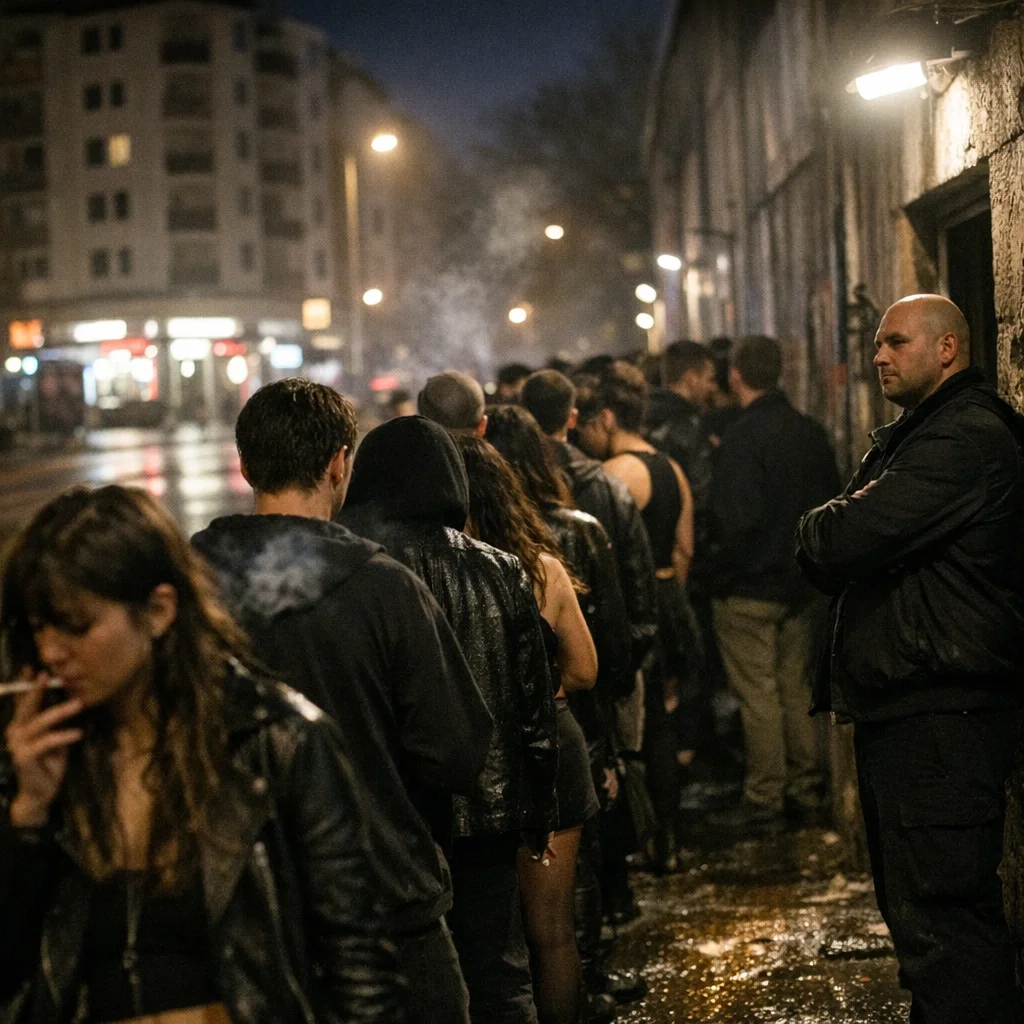
I learned nothing noble from my Berghain rejection, only the standard Berlin lesson that humiliation is a public utility and the city would like to charge you VAT for it. You stand outside a former power plant in Wedding’s after-hours bloodstream, dressed like you are either seeking transcendence or a person to make you worse, and some black-clad gatekeeper with the dead eyes of municipal procedure decides your face is too eager, too available, too expensive-looking for the wrong reason. The door does not close. It censors.
By midnight, the whole street feels like an audition for a collapse the city can monetize later. The queue is a long, damp ribbon of ambition: NGO interns in thrifted leather pretending they have read enough theory to deserve this, crypto refugees with faces like overfed passwords, art-school nihilists wearing grief as outerwear, and municipal functionaries off-duty but still somehow in character, as if they escaped the office only to continue serving denial in a more flattering light. Everyone has a story. None of them are better than the line.
Wedding, of course, does not care. Wedding is where the city’s self-mythology runs into rent arrears, Turkish bakeries, late-night kiosks, and apartment buildings that smell like radiators and old compromise. On Müllerstraße, a courier leans on his bike and laughs at a group of people in black mesh and orthopedic sneakers discussing “access” like they invented doors. At Leopoldplatz, a woman in a puffer coat drags a shopping trolley past three men arguing about which warehouse party is “more ethically curated,” which is a phrase that should be punishable by public mopping.
That is the joke Berlin keeps telling itself: that exclusion is sophistication if you put enough smoke around it. The club line is only the most glamorous branch of the city’s wider administrative kink. Housing offices make you wait months for a form that will deny your life in a font size chosen by a coward. Cultural institutions preach openness while practicing selection with the tenderness of a customs officer. Techno, housing, arts funding, residency permits, neighborhood consultations: different desks, same smile, same algorithm of quiet humiliation. The city calls it diversity because it prefers its cruelty in a tote bag.
Murat Kaya, who runs a Turkish bakery two blocks away and has seen every variety of Berlin self-invention stagger past his window at 3 a.m., said the whole ritual looked like “a church run by ex-cons, interior designers, and people who say they are deconstructing masculinity while checking if their eyeliner survived the queue.” He handed me a sesame roll and added, with the mercy of a man who has sold bread to worse people than me, that “in Wedding, at least the liars buy something.”
The queue’s special talent is making adults behave like hungry students outside a free buffet. People rehearse indifference with the concentration of horny monks. They angle their bodies, soften their jaws, lower their laughter, and pretend not to be impressed by a door that has reduced them to pulse rate and styling. There is always one person in a leather harness and a dead-serious face who looks less like a rebel than a compliance officer for desire. There is always another who dresses like a budget apocalypse, as if poverty were a concept piece and not, in this city, a monthly invoice.
A club spokesperson declined to comment on individual rejections, which is sensible. No one should be forced to explain why a face was considered too eager, too smooth, too obviously in need of validation. The Senate’s nightlife office, asked whether this ritual contributes to Berlin’s cultural prestige, replied with its usual fog machine of civic virtue: “diverse cultural ecosystems.” That phrase deserves to be framed, hung in a corridor, and used to swat flies. It means: let them stand there long enough and they will mistake neglect for art.
The official language of Berlin is always the same. It calls scarcity “management,” gatekeeping “quality assurance,” and social sorting “community preservation.” It outsources cruelty to bouncers, clerks, landlords, and committees, then washes its hands in procedural neutrality. This is how the city keeps its conscience clean while its residents rot in beautiful rooms they cannot afford. The queue outside Berghain is only the visible version: a premium line for the emotionally insured.
I went back the next weekend and watched the same procession repeat itself: the hopeful, the powdered, the overconfident, the spiritually underdressed, the ones who had clearly mistaken self-regard for charisma and charisma for entry. Some were admitted. Some were not. Wedding kept breathing around it all, indifferent and slightly amused, as if the neighborhood already knew the ending. I was not transformed. I was not purified. I was simply taught the city’s favorite liturgy: in Berlin, rejection is not a failure of the system. It is the system, wearing better shoes.