Your New Neighborhood Council, Brought to You by Astroturf
Wedding’s latest civic initiative lets residents “co-create” the future through paid workshops, branded feedback forms, and a volunteer list that somehow always contains the same three men with consultancy haircuts.
Gentrification Symptoms & Pretend-Creative Economy Reporter
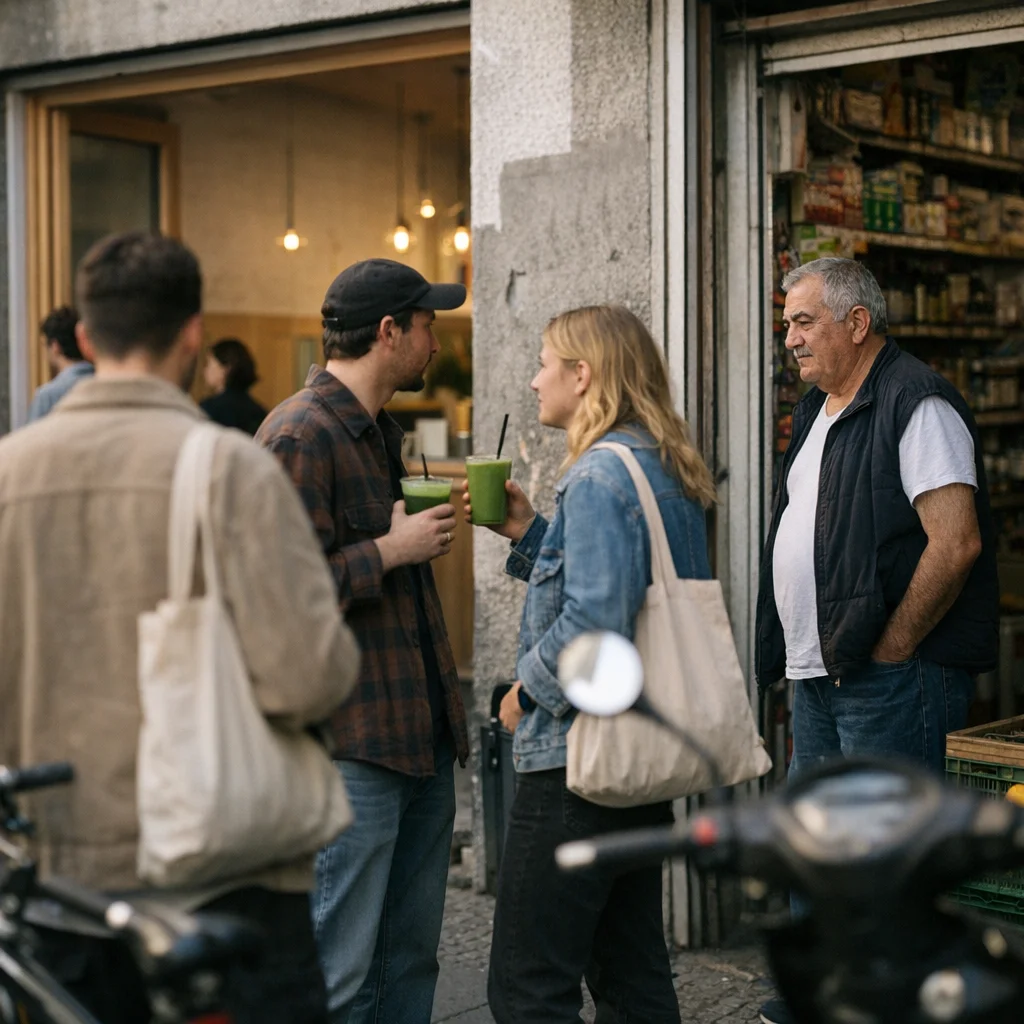
Residents in Wedding spent Tuesday morning watching another corner storefront get repainted into the kind of neighborhood improvement that arrives with clean fonts, soft lighting, and a lingering smell of institutional deodorant. It is an organic juice bar now, with handwritten prices, a pale wooden counter, and staff who talk about carrots like they are managing a peace process. The shop opened on the ground floor of a building near Müllerstraße where a Turkish bakery had lasted long enough to be mistaken for permanence, and then disappeared after the lease renewal went the way of cheap dignity and anyone who still believed in the phrase “local character.”
By noon, the new place was already full of people holding celery stalks like they had invented labor. One man in a navy overshirt tapped his card for an eight-euro beet juice and announced, with the wet certainty of a man who has never once been embarrassed by his own reflection, that he was “investing in the neighborhood.” Across the street, a kiosk owner who has been selling cigarettes, gum, and bad luck for 19 years said the neighborhood was also investing in her blood pressure. “They sell wellness by the glass and call it community,” said Hülya Demir, whose family has kept a small shop nearby since the 1990s. “It’s rent with a smoothie filter.”
This is how the district now performs democracy: not with power, which would be vulgar, but with workshops. First comes a flyer in cheerful municipal German announcing “participation opportunities.” Then the paid moderation. Then the feedback forms with their little boxes for fear, grief, and fantasy, all flattened into categories by a consultant with a sad middle part and shoes that cost more than a month of someone’s electricity bill. The same three men show up to every session—startup dad, NGO apostle, freelance strategist—each one carrying the same reusable cup and the same expression of expensive innocence, as if they were born during a panel discussion and still think accountability means a round of applause.
The district office, which can smell opportunity the way a shark smells mascara, said it welcomes “mixed commercial use” and “creative neighborhood activation.” That is the official perfume of displacement: a little civic language, a little grant-season optimism, and just enough fake humility to make the knife seem collaborative. One staffer with a haircut that looked budgeted for in advance said the district was “monitoring vacancy development,” which is bureaucrat for watching a neighborhood get undressed in slow motion while taking notes for a slide deck titled resilience.
At street level, the mood was less policy seminar than a public autopsy with catering. The Turkish grocer next door said the juice bar’s opening had already cut his morning traffic in half, because people who used to buy bread and cigarettes now buy cold-pressed salvation and leave looking morally improved, like they’ve just completed a minor spiritual cleanse and can therefore survive the humiliation of calling it local engagement. “They come here to feel clean,” he said. “Then they walk past me like I’m dirt with a license.”
The consultants call this “activation,” which is a lovely word if you enjoy watching a neighborhood get fingered by capital and thanked for its participation. They hold their workshops in borrowed rooms with potted plants, warm beer, and name tags that say things like facilitation and inclusion, as though the problem were that nobody had tried to be inclusive while the lease escalated and the storefronts went clinically sterile. The NGO types nod gravely, write down “community concerns,” and then convert the whole mess into a report with a title like Shared Futures in Transitional Spaces, which is the sort of sentence that can only be produced by people who have never once had to choose between paying rent and buying fruit.
By late afternoon, two bicycles were locked outside the juice shop, both with child seats and no children, which felt like the perfect emblem for the district: decorative, expensive, and prepared to carry someone else’s future until the invoice comes due. Around the corner, another storefront is already rumored to be “in transition,” that tender little euphemism for a business being gutted while everyone inside the civic machine smiles, takes a photo, and congratulates itself for preserving what it is actively replacing.