“Your Receipt Is Your Passport,” Says the Döner Line
A new order culture in Wedding turns the late-night kebab shop into a border crossing for people who want hot food without looking poor, drunk, or local.
Neighborhood Commerce & Low-Grade Dread Reporter
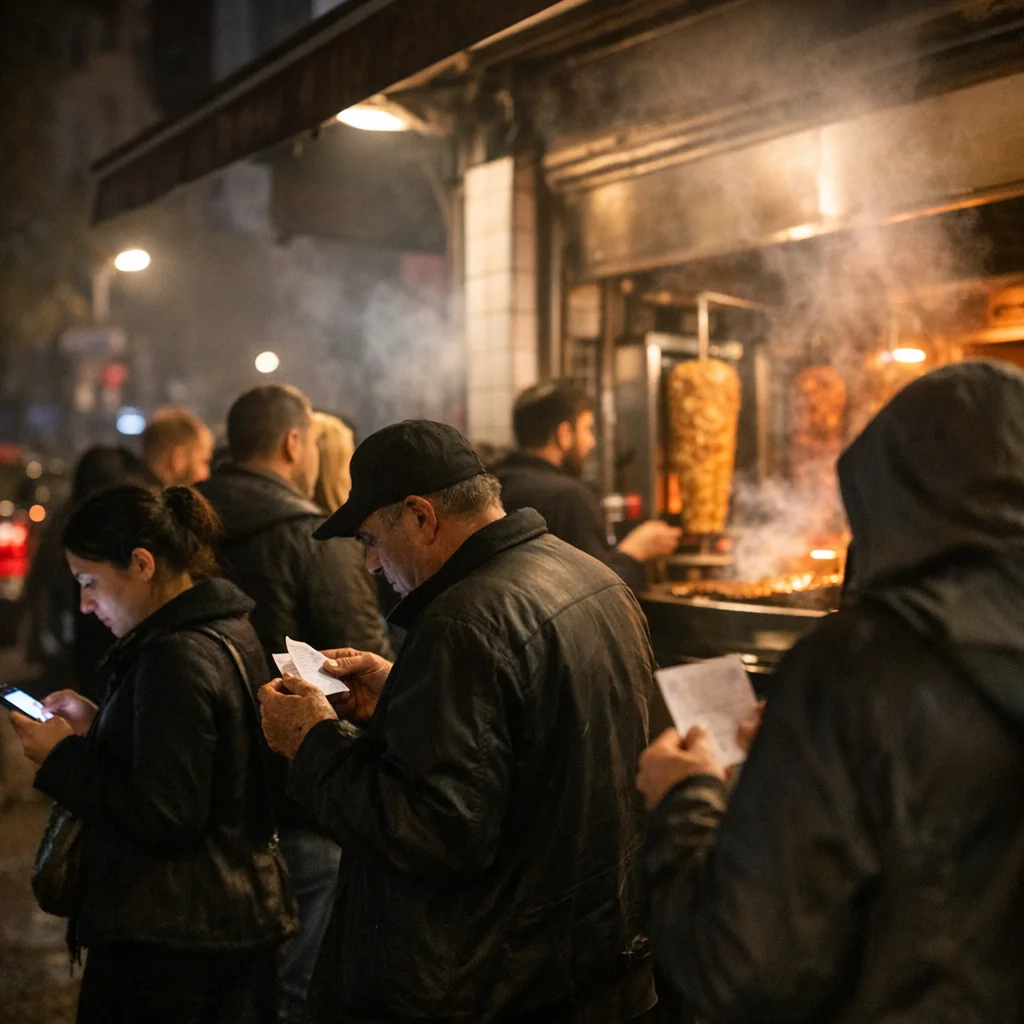
At a crowded Turkish-owned döner shop on a corner in Wedding, the late-night line now works like a miniature border post for everyone desperate enough to want hot meat without looking desperate. First came the receipt rule. Then came the faces lit by phone screens, the awkward patting of jacket pockets, the greasy-handed panic of people realizing they had already folded the slip into a shape too pathetic to survive scrutiny. By the end of the week, the queue stood in a kind of civic trance, as if a district office had been reincarnated as a kebab counter and decided the throat should wait its turn.
The owner, Mehmet Yildiz, said the new order was simple. “If you want food, you take a number, keep the receipt, and stop acting like the line is your personal stage,” he said, beside the grill and a stack of paper slips that carried more authority than half the people clutching them. “We are not doing performance art for freelancers who just discovered the neighborhood and think hunger makes them interesting.”
The rule spread after a stretch of ugly evenings, when customers arrived loud, perfumed, and a little chemically heroic, then began arguing over who had waited longest as though the city owed them an erotic little triumph for standing still. The shop started enforcing receipts because some people treat a döner line the way they treat Berlin: as a place to arrive hungry, posturing, and slightly entitled, then complain when reality refuses to flatter them.
That made the place into a public humiliation booth with extra onions. The Neukölln-to-Wedding transplant in clean sneakers and expensive fatigue now clutches a paper slip like a visa, terrified of being clocked as the sort of person who talks about “community” while missing the texture of actual waiting. The old regulars — Turkish fathers, night-shift workers, boys with fried hair, women who know exactly how much sauce a man can deserve — watch the newcomers with the flat patience of people who have seen every imported conscience eventually get hungry and obedient.
A district spokesman said no special permit was needed for the queue system, though he added that “customer flow should remain accessible and non-discriminatory,” which is the kind of sentence Berlin produces when it wants to sound humane while worshipping a clipboard. Here, every bureaucrat with a lanyard believes dignity is just process with better posture. The BVG, reached for comment after several customers reportedly missed their last train while staring at food they had not yet earned, declined to say whether the line counted as a transit connection or simply another form of punishment.
One student from Neukölln, who asked not to be named because her scarf was “giving mixed signals,” called the rule “a bit authoritarian.” She said this while still waiting, which is the sort of sentence Berlin allows when someone wants to flirt with oppression without risking a stain.
The deeper joke is that the shop has done what planners, activists, and corporate empathy consultants cannot: it has made everyone behave by making them hungry enough to accept the terms. Not respect. Appetite. The city’s fake egalitarianism collapses instantly once paper slips, numbers, and public patience enter the room. Leftists queue like penitents. Tech bros stand there with the dazed humility of men who think they are above being seen and are, in fact, one sauce drip away from collapse. Consultants, those permanently moisturized priests of inconvenience, look especially ridiculous when they realize authority can be handed out by the minute along with garlic sauce.
The line is a border regime with sesame seeds. It decides who gets in, who waits, and who has to stand there pretending not to smell like last night. It turns Berlin’s beloved administrative fetish into a joke with a grill attached: obey first, eat later, and do not confuse your self-image with your number.
By closing time, the receipts were gone, the grill was smoking, and the line had learned what the city always teaches in the end: if you want to be fed in public, you will submit in public first. In Wedding, the neighborhood still knows how to make the fashionable city show its papers.