ZDF Demands Mandatory AI Courses — Wedding Answers by Turning the Completion Certificate Into Rent, Coffee, and a New Permit System
While ZDF argues about who needs 'AI literacy', the Kiez already weaponized the certificate: landlords, baristas and buskers now treat the little hologram as the real civic test.
Civic Amnesia & Lifestyle Compliance Correspondent
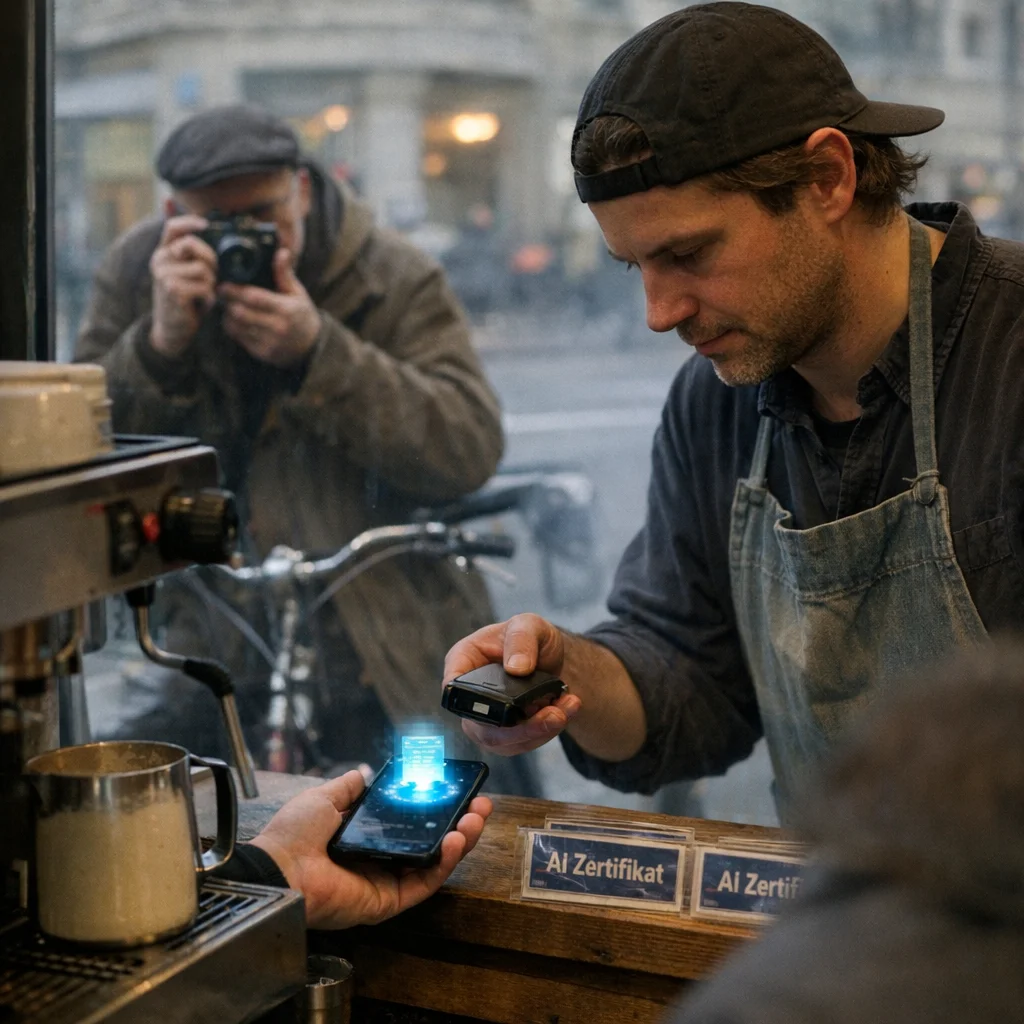
When public broadcaster ZDF floated Pflichtschulungen zu KI, Wedding answered within a week — not with policy, but with price lists. What began as a national debate about who needs "AI literacy" has mutated here into a petty economy of completion certificates: landlords, baristas and hairdressers now treat the little hologram as the real civic exam.
It started Monday, when landlord Mehmet Kaya of a two‑flat on Müllerstraße offered tenants a “compliance discount” if they uploaded a certified course badge to his inbox. “If your phone shows the holo, I’ll shave off two weeks’ rent,” Kaya said. “Proof you won’t sue me for renovations—that’s worth money.” Within hours the corner café across the street installed a plexiglass stand that asks customers to show AI certification before pouring oat milk. “We won’t risk our microfoam,” said barista Lena Vogel, leaning on a tamper. “Our customers are picky; they want ethics and a receipt.”
By midweek the haircut salon next door, Chop & Chat, advertised "express modules": a thirty‑minute primer, a laminated sticker, and a complimentary stickered espresso. Owner Simin Arslan shrugged. “People want the sticker more than the learning. We give them a sticker and a story,” she said. “It’s easier than penetrating the bureaucracy.”
The holograms themselves behave oddly: several residents reported the tiny projection briefly flashing the last app they used when scanned under fluorescent light — an effect that has ruined more than one political argument in the queue. A city official at Bezirksamt Mitte called the phenomenon “an unregulated social experiment” and warned businesses not to condition services on uncertified documents. “We do not endorse private certification as a new form of ID,” said spokesperson Katrin Hesse. The district office promised guidance “in the coming days.”
A representative from the local tenants’ association accused landlords of exploitation. “This is a circumvention of tenant law,” said Nora Ilkay, who runs eviction prevention workshops. “They’re commodifying compliance.” Meanwhile, a group of expats staged a photo op—certificates fanned like playing cards—complaining about digital illiteracy while their landlord’s bank transfer slid in from abroad.
The improvised economy has created contradictions worthy of a Byung‑Chul Han lecture: digital self‑optimization sold back to citizens as proof of virtue. It is also, simply, very Berlin — performative credentials exchanged for daily conveniences. Some residents joke that Kafka would have loved the serial number; others say Hannah Arendt is too tired to care.
The immediate consequence is practical: Bezirksamt Mitte will hold a hearing next week and a consumer protection lawyer has signaled potential litigation. In the meantime the holograms keep circulating, oat milk is intermittently withheld, and landlords are counting stickers like rent receipts. No one expects ZDF’s debate to stop the sticker economy; bureaucracy here is getting into tight spaces and sliding sideways, and the legal system will have to go all the way to catch up.