Zelensky’s ‘Better No Deal’ Mantra Lands in Wedding — And the Fountain Has Opinions
After President Zelensky said he'd prefer no peace than a bad one, Wedding’s activists, developers, and a Turkish bakery argue over virtue-signaling while a fountain begins spitting tiny peace flags.
By Olga Sodcom
Imported-Outrage & Kiez Satirist
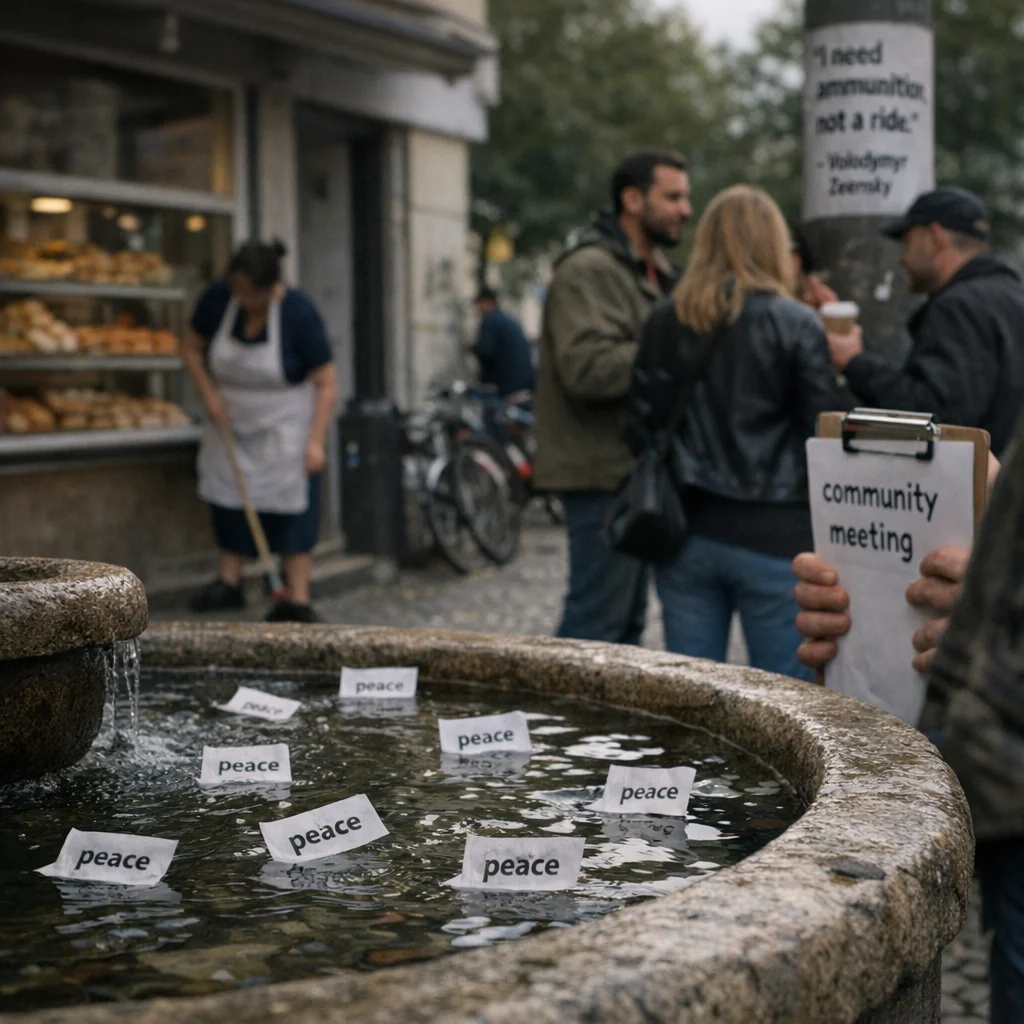
When Volodymyr Zelensky publicly declared he’d rather have no peace than a bad peace, the sentence took a flight path through Twitter, past two think‑pieces, and landed as a manifesto taped to a lamppost on Müllerstraße.
By noon, the lamppost had been annotated, translated into English for brunch crowds, and debated in an emergency planning meeting at the community center. The discussion was predictably split: one side demanded purity—no compromise that erased Ukrainian suffering; the other side wanted a quick, marketable reconciliation everyone could pose with for an Instagram deadline.
It was the sort of argument Clausewitz might have called 'strategy confused with virtue.' Here, it read like a humanities seminar taught by people whose politics begin and end at the espresso machine. A local co‑op offered to host a “solidarity pop‑up” whose business model consisted of selling ethically sourced remorse in reusable jars.
Then the fountain on the square, an unglamorous patch of municipal sculpture, did something no one had budgeted for: it started spitting tiny paper peace flags. They weren’t wet banners or political placards—just stiff, printed rectangles the size of a cigarette card. They floated across the cobbles like confetti from a badly received parade.
Nobody panicked. A woman from the Turkish bakery opposite shrugged, handed a sesame roll to a man accusing the muralists of opportunism, and said, in heavily accented German: “If you want real peace, you bake it.” Her answer displeased no one and silenced several performative activists who realized their moral climax might be hungry work.
Developers tried to slide a backdoor rider into the meeting agenda—an offer to fund a “peace corridor” if the neighborhood allowed outdoor seating on public land. The pause that followed had the sexual awkwardness of two people trying to get into tight spaces while keeping their reputations intact. Compromise flirted with corruption, then ground to a halt when someone pointed out the corridor’s floor plan had more exits than answers.
Local radicals took Zelensky’s line as a blunt instrument and refined it into a purity test: no deal signed faster than a manifesto could be posted. Expats translated moral certainty into English hashtags and then lectured a man who’d been in the street for thirty years about historical nuance.
It ended, as these things do, with applause, a half-formed petition, three NGOs promising to consult, and a Muslim grandmother from the bakery sweeping up the tiny flags into a neat pile. She folded one between her fingers, read the headline aloud, and tossed it into the compost. "No bad deal," she said, "means you keep the good things. Or you keep baking." It was simple, ruthlessly practical, and uncomfortably true—like Arendt meets a broom.
The fountain kept spitting flags, politely refusing to pick a side. In Wedding, even geopolitics can be performative. But sometimes the quiet answer comes with flour on its hands.